How to choose the right rental car in Iceland
The right rental car in Iceland depends entirely on where you are planning to drive.

Jan In Iceland
Iceland

If you’re staying mostly on the Ring Road in summer, almost any normal rental car will usually be fine.
If your route includes a lot of gravel roads, I would start thinking more about comfort, clearance, and peace of mind. A small car can handle many regular gravel roads, but potholes, loose stones, washboard roads, and sharp rocks can make the drive less comfortable and increase the risk of damage. In that case, a larger car, SUV, or 4x4 can be a better choice.
❄️ In winter, or even during shoulder season, my personal opinion is simple: I would not rent anything other than a 4x4 in Iceland.
And if you’re visiting during the colder months, I also recommend watching my winter driving guide, because choosing the right car is only one part of driving safely in Iceland.
The biggest mistake people make is with F-roads.
Many travelers hear “4x4” and assume they can drive anywhere in the Highlands, but that’s not how it works.
Some easier F-roads, like F35 or parts of the route to Landmannalaugar, are roads where I would personally feel comfortable in a regular mid-size SUV or smaller 4x4, such as a Dacia Duster, Suzuki Vitara, Nissan X-Trail, or a similar car.
But other F-roads are much more serious. Some have bigger river crossings, rougher terrain, deep potholes and ruts, steep sections, and conditions that can change quickly depending on the weather.
For those roads, you want a more capable vehicle, such as a Land Cruiser, Hilux, Wrangler, or a properly equipped 4x4 with good ground clearance.
If you’re trying to keep the rental price lower, cars like a Suzuki Jimny or Dacia Duster can be surprisingly capable on some routes because they usually have better clearance than many other affordable rental cars and decent 4x4 ability.
But that does not mean they are the right choice for every F-road, especially not for serious river crossings.
A snorkel can help, but it is not something every rental company provides, and it does not magically make a car safe to drive through any river.
Before driving any F-road, research the exact road, check the current road conditions at road.is, understand what kind of terrain and river crossings are on the route, and never assume that “4x4 allowed” means “easy.”
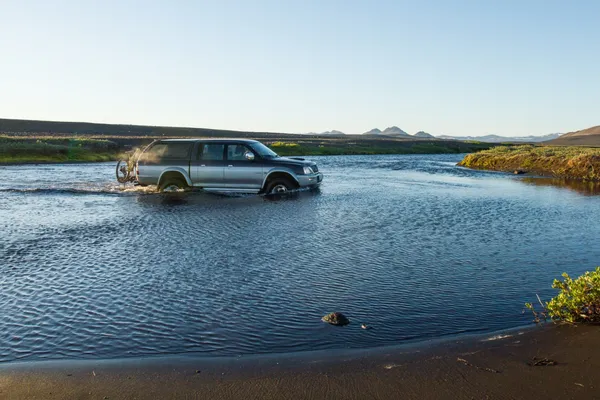
If you arrive at a river crossing and you’re not sure, don’t just drive in and hope for the best.
If it looks shallow, slow, and safe enough to check on foot, good practice is to take off your shoes, pull up your pants, and walk it first so you can check the depth and the surface underneath.
To give you a rough idea, some smaller 4x4s and SUVs may only have a wading depth of around 30-35 cm, which is about 12-14 inches.
Some mid-size SUVs may be closer to 40-50 cm, which is about 16-20 inches.
More capable vehicles like a Land Cruiser or Hilux can be around 70 cm, which is about 27.5 inches.
But don’t treat these numbers as permission to cross.
It depends on the exact model, year, modifications, load, current, riverbed, and how the vehicle is driven.
If you’re still not sure, don’t cross. Turn around, wait for another car to drive it first, or choose a different route.
Water damage is usually not covered by rental insurance, and damaging a rental car in the Highlands can get very expensive very quickly.
No photo or viewpoint is worth ruining your trip over.
My simple advice:
Don’t rent a car based only on price.
Rent it based on the route you actually want to drive.
And if you’re still looking for a rental car or camper van, you can find my discount codes from trusted rental companies here:

Hledáš, co podniknout?
Podívej se na mého průvodce s nejlepšími bezplatnými aktivitami, itineráři a cestovními tipy pro nezapomenutelný výlet.